Where to Watch
Not currently available on any tracked streaming platform.
Overview
Quick summary (TL;DR)
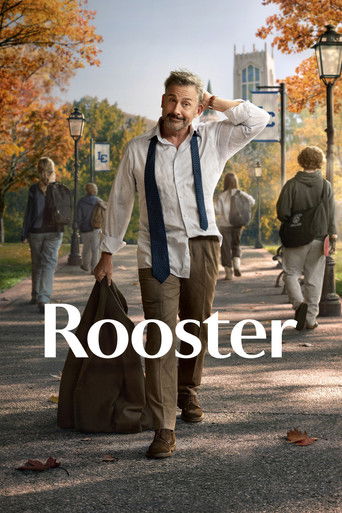
Rooster, the 2026 comedy series created by Bill Lawrence, presents a focused look at the life of an author navigating the social and emotional hurdles of a college campus. Starring Steve Carell, the show moves away from high-concept gimmicks to explore the “complicated relationship” between a father and his daughter. With a steady 7.5 rating from early viewers and a confirmed status as a returning series, it has established itself as a reliable, character-driven entry in the streaming landscape. It is a show that values the slow reveal of character over rapid-fire punchlines, making it a suitable choice for viewers who prefer their comedy with a side of academic introspection.
Story and premise
The narrative foundation of Rooster is built upon the specific environment of a university campus, a setting that serves as both a workplace and a site for personal reckoning. The central figure is an author who, despite his professional success, finds himself in a position of vulnerability. The tagline, “He’s here to learn,” serves as the show’s guiding principle, suggesting that the protagonist’s arrival on campus is less about his literary contributions and more about his personal education. This education is primarily facilitated through his “complicated relationship” with his daughter, who is also present in this academic sphere.
The premise avoids the typical tropes of the “fish out of water” story by grounding the conflict in the history between these two characters. The comedy arises from the friction of their shared space and the inevitable overlap of their private and public lives. By focusing on an author—a person whose career is built on observation and narrative—the show creates an interesting irony: the man who writes stories for a living is struggling to navigate the reality of his own family life. The college setting provides a structured backdrop for this exploration, offering a variety of social pressures that test the protagonist’s patience and his willingness to change. The show does not rely on external plot twists, remaining instead within the boundaries of its collegiate setting to explore how these two individuals attempt to coexist.
Performances and craft
Under the direction of creator Bill Lawrence, Rooster benefits from a clear comedic vision that prioritizes ensemble chemistry. Steve Carell leads the cast with a performance that likely draws on his established ability to portray well-meaning but flawed individuals. He is supported by a notable group of actors, including Danielle Deadwyler and Phil Dunster, both of whom bring a level of gravitas that balances the show’s lighter moments. The inclusion of John C. McGinley suggests a nod to Lawrence’s previous work, potentially offering a more seasoned comedic presence, while Lauren Tsai rounds out the main cast, bringing a fresh perspective to the collegiate environment.
The craft of the show is evident in its pacing and its refusal to lean on the broader slapstick often found in the comedy genre. Instead, the writing focuses on the nuances of the father-daughter dynamic and the specific intellectual atmosphere of a university. The 7.5 average score reflects a positive reception to this more restrained approach. As a returning series, the production has the opportunity to deepen the established conflicts, moving beyond the introductory phase of the first season to see how the protagonist’s “learning” process evolves over time. The result is a series that feels intentional and well-constructed, relying on the strength of its performers and the clarity of its premise to maintain viewer interest across its initial season.