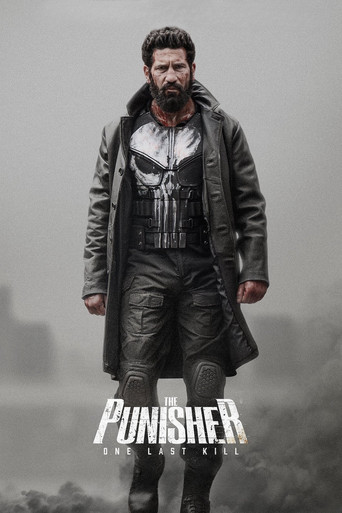
A Marvel Television Special Presentation – The Punisher: One Last Kill (2026)
"Hey Frank."
Where to Watch
Not currently available on any tracked streaming platform. Check back soon.
Overview
A Marvel Television Special Presentation – The Punisher: One Last Kill — Quick Overview
The 51-minute runtime of A Marvel Television Special Presentation – The Punisher: One Last Kill serves as a sharp, concentrated look at a character often lost in the noise of larger cinematic universes. Instead of a sprawling season of television, this format allows for a precise exploration of Frank Castle’s psyche. It is a dense piece of filmmaking that prioritizes the internal state of its protagonist over the typical spectacle associated with the genre. For those who felt the previous iterations of the character were occasionally bogged down by subplots, this special offers a streamlined narrative that feels both urgent and reflective.
What stands out immediately is the shift in tone. While the R-rating ensures the visceral nature of the character remains intact, the focus here is on the quiet moments. The special manages to balance the heavy themes of the Drama and Crime genres without losing the propulsive energy required of an Action title. It feels less like a traditional superhero entry and more like a gritty, standalone character study that happens to feature a man with a very specific set of skills and a dark history.
Story and Script
The narrative foundation of A Marvel Television Special Presentation – The Punisher: One Last Kill is built on the idea of transition. The official overview describes Frank Castle searching for meaning beyond revenge, a significant departure from the singular drive that has defined him for years. This internal search suggests a man who is exhausted by the cycle of violence, looking for a way to exist in a world where his primary enemies have already been dealt with. It asks a difficult question: what does a soldier do when he no longer has a war to fight? This thematic depth elevates the script above standard vigilante fare.
However, the tagline “Hey Frank” hints at a personal connection that disrupts this search for peace. The script utilizes an “unexpected force” to pull Castle back into the fray, ensuring that his attempt at a quiet life is short-lived. This narrative device creates a compelling tension between the man Frank wants to be and the man the world requires him to be. Because the runtime is limited to under an hour, the script doesn’t waste time on filler. Every scene serves the dual purpose of advancing the plot and deepening our understanding of Frank’s current mental state. The 8.6/10 score from early viewers likely reflects this efficiency and the emotional weight of seeing a familiar character grapple with existential dread.
The “unexpected force” mentioned in the overview remains the primary catalyst for the action. By not explicitly naming a specific villain in the promotional materials, the story maintains a sense of mystery. It forces the audience to focus on Frank’s reaction to the conflict rather than just the conflict itself. This approach allows the Crime elements of the story to feel grounded and personal, rather than world-ending or overly theatrical. The script focuses on the consequences of a life lived in the shadows and the difficulty of ever truly leaving that life behind.
Cast and Direction
Jon Bernthal returns to the role with the same intensity he has always brought to Frank Castle, but there is a noticeable weariness in this performance that aligns with the story’s themes. He is supported by a cast that brings significant dramatic weight to the production. Deborah Ann Woll and Jason R. Moore return, providing a necessary link to Frank’s past and his few remaining human connections. The addition of Judith Light and Kelli Barrett suggests a narrative that involves complex social or familial dynamics, adding a layer of prestige to the ensemble. The chemistry between these performers helps ground the more heightened moments of the Action sequences in a recognizable reality.
Director Reinaldo Marcus Green brings a specific aesthetic to the project that distinguishes it from previous Marvel entries. Known for his work on character-driven dramas, Green focuses on the texture of the environment and the subtle shifts in his actors’ expressions. His direction ensures that the 51-minute runtime feels substantial. He treats the Crime elements with a somber realism, avoiding flashy camera work in favor of a steady, deliberate pace that mirrors Frank’s own cautious approach to his new life. The R-rating is utilized not for shock value, but to maintain the integrity of the world these characters inhabit.
Should You Watch A Marvel Television Special Presentation – The Punisher: One Last Kill?
If you are looking for a story that treats its protagonist with maturity and respect, then A Marvel Television Special Presentation – The Punisher: One Last Kill is a mandatory watch. It caters to those who appreciate the intersection of character drama and high-stakes conflict. Fans of Reinaldo Marcus Green’s previous work will recognize his signature focus on complicated men navigating difficult circumstances. It is a production that understands the value of brevity, delivering a complete emotional arc in less time than a standard feature film.
Ultimately, A Marvel Television Special Presentation – The Punisher: One Last Kill succeeds because it doesn’t try to be more than it is. It is a focused, gritty, and thoughtful look at a man trying to find his place in a world that won’t let him go. Whether you are a long-time follower of Frank Castle’s journey or a fan of tight crime dramas, this special offers a rewarding experience that lingers long after the credits roll. It proves that sometimes, a shorter runtime can lead to a much more impactful story.